Monday, 28 May 2018

Logopolis


4 Episodes
Aired between 28th February 1981 and 21st March 1981

Written by Christopher H Bidmead
Produced by John Nathan-Turner
Directed by Peter Grimwade

Synopsis

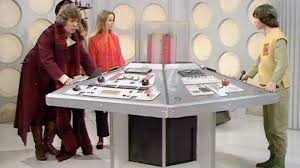
The Doctor and Adric are taking a tour of the TARDIS interior, noting that the ship is gradually decaying from its age when the Cloister Bell sounds.  The Doctor says it's a sign of impending doom.  He decides that the best thing to do is to give the TARDIS an overhaul, and fix the chameleon circuit whilst he's at it.


To do this, he takes them to a Police Box on earth in 1981, landing on top of it so that the real police box is transported inside the console room, and they can take the appropriate dimensions of the box that they'll need.


The Doctor's intent is to go to a place called Logopolis, where the scientists there will be able to use the dimensions he provides to effectively re-make the TARDIS from the ground up.


Little does the Doctor know however that the Master has done the exact same thing as him very shortly before (hinting at some form of telepathy between the Time Lords). This leads to a form of time loop where going in the doors of one TARDIS leads into the console room of the other.  The Doctor and Adric go off to find the Master in this recursive labyrinth.

Meanwhile, a young lady called Tegan Jovanka struggles with her old car to get to Heathrow Airport, where she's about to start her new job as an air hostess.  Her Aunty Vanessa is with her to help her along, but they get a flat tyre and are forced to pull up near the box.  Trying to call for help, Tegan enters the TARDIS and gets lost in the interior.


Whilst she does so, the Master nips out and kills Aunty Vanessa with his handy Tissue Compression Eliminator.  Why?  I don't know.

Not being able to find the Master, the Doctor decides on a bonkers plan to flush the Master out by opening the doors whilst at the bottom of the Thames.  Thankfully, the TARDIS actually materialises on a boat instead, missing target by mere feet.  As they inspect what went wrong, the Doctor sees a mysterious white figure.

He speaks to him alone and comes back looking very sombre.  He decides to go to Logopolis instead, taking Tegan inadvertently with them.


Once on Logopolis, they are greeted by the chief scientist known as the Monitor.  He assures them that he can use a very complex form of mathematics known as block transfer computation to re-design the TARDIS as requested.

Nyssa turns up and says that a friend of the Doctor's brought her here.  She's looking for her father who went missing.

It doesn't take long however for the master to begin messing things up, shrinking lots of Logopolitans, tricking Nyssa into believing he is still her father, and trying to sieze control of the planet by using a technological device to silence the Logopolitans from speaking their mathematical equations.


This backfires however, as it turns out, that the universe should have decayed and died a long time ago because it's something called a closed system (it's finite).  The Logopolitans have staved off the end of the universe by using a replica of the Pharos Project on Earth to effectively open up dimensions via CVE's (see Full Circle) thereby creating more and more "space" and keeping the system open, therefore staving off entropy.  Now that the Logopolitans cannot do that, the universe suddenly begins to die!

All this mayhem means that it's too late for Logopolis and the Doctor forces Adric, Nyssa and Tegan into the TARDIS which is taken by the mysterious white figure out of the known universe and time stream to keep them safe.


They watch helplessly as entire worlds and solar systems begin to blink out and die - one of them being Traken.

The Doctor meanwhile stays behind and is forced to work with the Master.


They determine that whilst the replica of the Pharos project is beyond saving, the data in its computer banks is still there, so the real Pharos project on Earth could be capable of restoring balance.  He, the Master and Tegan (who jumped ship) go to Earth and try to get to the control room on the radar dish.  Tegan gets left behind and finds Adric and Nyssa as they convince the white figure (they call the Watcher) to bring the TARDIS to Earth.

They look on helplessly as the Doctor and the Master get up to the dish.  They setup the dish to open up more CVE's and provide stability but the Master holds him at gunpoint, sending out an ultimatum to the universe that if they don't recognise his rule, he will close the CVE.  The Doctor sprints onto the gantry, trying to disconnect the cable that the Master would use to carry out his threat, but the Master re-aligns the dish tilting it.


The Doctor does disconnect the cable, but falls from the gantry in the process.


The companions race to the Doctor's side as he lies on the ground.  He says that "this is the end, but the moment has been prepared for" and reaches out to the mysterious white figure who then melds with him to regenerate into the next Doctor...


Trivia


  • The story was the brainchild of Christopher H Bidmead, who was going out as script editor because he'd had enough.  He thought of the idea from Keeper of Traken when the Master escapes from the Melkur in his TARDIS - so it was a TARDIS within a TARDIS.  The first instance of this though was of course, the Time Monster.
  • The watcher was meant to be mysterious and alluded to as the possible new form of the Master.  That's why he wasn't shown for the first couple of episodes. Unfortunately, the ending of the Keeper of Traken showed us everything and spoiled all the effort they went to on this
  • The character of Tegan was designed by John Nathan-Turner.  He created it because Australian broadcasting were talking about a co-production and he wanted to justify a jolly to Australia, so he put an Australian character in.  
  • When designing the character, JNT asked for the character to be called something like Tegan OR Jovanka, but that got muddled in the process and her full name became Tegan Jovanka.  
  • The house Tegan leaves actually belongs to one of the writers of Meglos.
  • Finally, we can't end this without talking about good old Tom.  This wasn't the ending he was hoping for, and he made sure everyone knew about it.  His general depression about the direction the show was going, and his recent illness all took their toll on him.  He was grouchy to the end, and whilst it was the end of an era, many of the crew would breathe a sigh of relief when he left


The Review

This is the end indeed. Tom Baker wanted it spectacular with high stakes, shooty lasers and big explosions.  Whilst that might have been a bit over the ever tightening budget, it could have been done something like it.

Now, if you're an intellectual and into scientific theory, then you'll probably think this review is dumbing things down or assume I just didn't "get it". That's not the case.  Oftentimes, we argue that Doctor Who plays it too safe and child-friendly for the audience and they can afford to do more high brow things and explain more complicated processes.  I totally agree with that, but in my opinion, Logopolis does so at the expense of drama.

The scientific concept of entropy destroying the universe unless you open up other dimensions is cool (and is supposedly used by Isaac Asimov himself as the basis of a story).  Having a recursive loop of TARDIS' is cool even if it's been done before, and if done right, the shrink-killing of lots of people could be terrifying.  Indeed, Logopolis has arguably the highest body count of any Doctor Who story yet told, it's just that most of them are off screen and not referred to other than lights of stars blinking out.

My problem with Logopolis is that it's full of techno-babble.  Whether real or made up, I don't care. It's just too dense to get any enjoyment from it, and it's sold in a way that it practically pauses for you to be impressed when someone spouts out a long and complicated theory.  It's frankly impossible to relate to. The only character you can do that with is Tegan who spends all her time either decrying the usefulness of men, or crying about the fact that she's hopelessly lost and wants to go home.

To add to the misery. the Master is chaotic at best, having no real motive and just going with the flow, trying his hand at a couple of evil schemes just because. I mean, he could have been joking about the CVE, but how would he realistically enforce his rule?  How would he know if they'd refuse his rule?

At least you can say that the main actors were reasonably good at their performances, but the supporting ones - especially the guards and policemen were agonisingly bad.

Rating 

4 out of 10

Rewatchability Factor

4 out of 10

Watch this if you liked...


  • Planet of Fire

Friday, 18 May 2018

The Keeper of Traken


4 Episodes
Aired between 31st January 1981 and 21st February 1981

Written by Johnny Byrne
Produced by John Nathan-Turner
Directed by John Black

Synopsis

Whilst on their way to Gallifrey, the Doctor and Adric are visited by an old man known as the Keeper of Traken.  His planet (Traken) has a society based on everyone "being terribly nice to each other." This niceness has been infused in some kind of matrix style technology that immobilises any evil people that set foot on the planet.


The keeper asks the Doctor to help as he's almost dying and that will diminish the power on the planet and put them at risk.  The Doctor is asked to help the transition.

On Traken itself, the citizens celebrate the marriage of two of their rulers - members of the consul that runs the society - Kassia and Tremas.

Kassia has looked after one of the evil forces that has been immobilised in the gardens for many years.  They call it the Melkur.  Now they are married, Tremas' daughter, Nyssa is put in charge of looking after the Melkur.  No one knows however that Kassia is secretly despairing about the likelyhood of her new husband, Tremas, being chosen as the next keeper, being sent into the ether of the machine and effectively widowing her straight away.  The Melkur talks to her and forces her to start helping it, in return promising that it will make sure Tremas is kept safe.


As part of the Melkur's plan, it kills a guard near the gardens, just before the TARDIS arrives.


The Doctor and Adric are arrested for the murder, and when they try to go and get confirmation from the Keeper, the Melkur turns up.  The Keeper blurts out that evil has invaded the sanctum and they confuse the Doctor and Adric for being the object of that cry.  Despite this, Tremas acknowledges their clear intelligence, and uses them as prisoners under house arrest to help investigate the rise in strange readings of evil he's been taking in the area.

There's a couple of episodes that involve running back and forth from the palace, the garden and Tremas' house, and it's all related to either proving Adric and The Doctor aren't evil, doing something to find the TARDIS (that has been displaced in time by the Melkur) or with Kassia doing more and more shady things to ensure Tremas' safety.  This includes putting on a neck brace that gives her laser beam eyes, and allows the Melkur to see through her eyes and control her.


Ultimately, with the help of Kassia unknowingly sacrificing herself, the Melkur is placed in the matrix machine once the current Keeper of Traken dies and is turned into the new keeper.  He quickly assumes control and places Tremas and the Doctor under arrest.  The Doctor quickly works out what happens and he works with Tremas to mess up the matrix machine.  Before he can complete the work, he is captured and taken to the Melkur.  He is taken inside the matrix style machine, and discovers that the Melkur is actually a TARDIS and the real villain is the Master!


Slipping under the radar, Nyssa and Adric work together to build a servo-shutoff machine and mess up the matrix, allowing the Doctor to escape.


The machine messes up and destroys the Melkur, and thinking the threat is dealt with, the Doctor and Adric leave.  The Master however, had his own TARDIS within the Melkur TARDIS and he materialises on Traken, capturing Tremas and using his body to regenerate.


Laughing, the Master goes back into his TARDIS and dematerialises.

Trivia


  • Geoffrey Beevers was cast as the Master, unfortunately used only once. His costume was the same cloak as was used in the Deadly Assassin, but the mast was so deteriorated that they couldn't use it.  Beevers preferred to use his own face anyway so he could emote better.  As a side note, Geoffrey Beevers is the husband of Carolyn John (Liz Shaw).
  • As was typical of John Nathan-Turner, the Master was a last minute addition.  He suddenly decided that the show needed his return and made the writer and Chris Bidmead find a way to explain it in the script.
  • Another addition to the crew was Nyssa herself.  She was only meant to appear in this story, but the production team were so impressed with her acting that they asked if she wanted to stay on for a bit and become a companion
  • Actually, the above point, whilst true is not the full story.  There was method behind JNT's madness, as he had actually asked Liz Sladen to reprise her role as Sarah-Jane Smith, and Louise Jameson for Leela.  Both turned the option down, leaving him with a gap as he saw it.  Ultimately, he decided (probably randomly) that the show needed not one companion but three.


The Review

And so we come into the home straight of the Fourth Doctor's run.  At first it does feel nostalgic, with the Doctor and Adric lamenting the loss of Romana and K9, but oddly enough, thanks to Johnny Bryne's dialogue, we get to see a very brief and massively surprising glimpse of what life on the TARDIS could have been like with just Adric and the Doctor.  There's no hint of the whiny boy we would come to know, and the way he reacts to the Doctor is very funny and entertaining.

Anyway, on with the rest of the story.

The story set up, although having a lot of exposition at the beginning, it had a lot of good ideas and gave the sense of a genuine world with distinct customs. This story promises epic scope or at the very least multiple sub-plots or character arcs.  It doesn't quite live up to that though in my opinion as it gets bogged down in running backwards and forwards, and stupid inspectors getting knocked unconscious every three minutes.

The inclusion of the Master, whilst novel to see, is also confusing.  There's not really enough of a justification as to why he's there, or why he's spent years and years just sat in his TARDIS in the garden of Traken.

I suppose Nyssa doesn't show any real promise as a companion, but it's interesting to note that the Doctor never actually chose her as a companion himself.

This story has a lot to offer, even if it's slightly confusing at times.

Rating

8 out of 10

Rewatchability Factor

5 out of 10

Watch this if you liked...


  • Trial of a Time Lord 


Saturday, 28 April 2018

Warrior's Gate


Four Episodes
Aired between 3rd January 1981 and 24th January 1981

Written by Steve Gallagher
Produced by John Nathan-Turner
Directed by Paul Joyce


Synopsis

Trying to find their way out of E-Space, the Doctor, Romana and Adric end up in a time disruption (effectively "nowhere" in time).  You would expect this place to be totally empty, but as it happens, it's got a big spaceship in it, navigated by a lion-like alien and manned by a Dad's Army crew of inept space traders. Their leader, Rorvik, is clearly hurting the alien by forcing him to help them by using it's mind to effectively "imagine" them out of the limbo their trapped in.


The alien finds the TARDIS and manages to escape, using it's unique power to run through time.

Meanwhile, the TARDIS is also struggling in limbo and the Doctor, with no better ideas debates some pre-determination and whether he should just start pressing random buttons which would bring them to where they were meant to be anyway.


As they debate this, the lion alien breaks into the TARDIS and starts messing with the controls.  He says his name is Biroc and that he's a shadow of his own past and their future. Once he's pressed some stuff, it runs off again back into the white nothingness.

The TARDIS lands and Romana checks the console after it and K9 are damaged by the time winds from the open door. She discovers all the coordinates are at 0.  It's like they are at an intersection between the negative e-space and the positive n-space.  The Doctor decides to go off and look for Biroc, leaving the other two to repair K9.

The freighter as it happens has also landed nearby and whilst the Doctor is gone, Rorvik and his cronies head off and find the TARDIS.  Romana stalls for time by only appearing herself, and the crew take her prisoner, trying to use her like they used Biroc to navigate out of the limbo they're in. 


Adric takes K9 and tries to find them but K9 is seriously messed up and not working right, resulting them in getting separated and lost.

The Doctor finds a medieval archway and banquet hall with a mirror at the end and full of old rusted armour and skeletons.  The armour comes to life and it turns out they're robots!  They try to kill the Doctor and he escapes by ducking and they cut each other to bits. 


He takes them apart and learns that the machines are called Gundans.  They were built by humans who were enslaved by the lion-aliens (Tharils).  The Gundan's were rebels who took down the Tharils and ended their tyrannical reign. 


Meanwhile, Rorvik tells his crew to revive another Tharil and he leaves to find the Doctor whom he believes is alien enough to use the navigation chair without dying. As they are gone, a Tharil is awoken (a dangerous procedure) and it runs rampant on the ship.  It finds Romana and frees her,

Elsewhere, the Doctor gets close to getting some key information about the church like structure.  It's a gateway, possibly out of e-space.  He uses K9's power when he turns up to boost the signal, but the last Gundan decapitates its companion and runs into a portal of the mirror.  Rorvik and his crew turn up to capture the Doctor but the Doctor also escapes through the mirror.  Whilst there, he meets Biroc in an alternate dimension that's black and white.  Biroc takes the Doctor to a mansion.

K9 overhears the crew saying that the distances from the freighter, the TARDIS and the gateway are shrinking.  This info becomes significant, when eventually, they discover that the freighter is made up of dwarf star alloy, an incredibly dense material that is ultimately responsible for collapsing this pocket limbo like a black hole.  It means they have only a short time before everyone dies.

Meanwhile, Romana gets free and discovers that Rorvik and his crew are slavers, and have captured numerous Tharils that are in hybernation (the dwarf star alloy is the only thing the Tharils can't travel through). Romana meets up again with the revived Tharil (Lazlo) and they go through the portal to the mansion. 


Once there, they see a flashback to the past, where the Tharils are lording it over the humans.  They see the Gundan's turning up to kill them all, and then they're thrown back into the limbo where they are captured by the slavers.

Rorvik wants to use a giant lazer to blow up the portal and open the way out of this place, but the Doctor is certain it will just kill everyone.  Biroc appears to him and tells him to do nothing.


After a lot of running about, trying to stop the slavers, ultimately, Biroc's advice was right as the crew kill themselves with the backblast of their freighter as they try to blow open the portal.  The Doctor, and co. are on the other side of the portal thanks to Biroc, and Lazlo revives some of the remaining Tharils who phase out of time to escape the collapse of the limbo dimension. 

With everything safe, the Doctor aims to return to the TARDIS, but Romana opts to stay behind in the black and white dimension to help free the Tharils from other locations. 


She also keeps K9 so he can be repaired from the damage that the time winds did to him. 

This means that the Doctor and Adric leave via the portal and re-enter N-Space.

Trivia


  • The original conclusion to the e-space trilogy was meant to have been a political thriller involving Gallifrey and Romana's failure to return.  It was so long and messy however that in the end it was abandoned and replaced by another story called dream time
  • Even the script for the new story was significantly re-worked by Chritopher Bidmead and the Director - Paul Joyce.
  • Paul Joyce was ambitious and more suited to working on feature films.  He took ages trying to get the perfect shots and often overrun, costing the BBC money and getting many people's backs up including Barry Letts and John Nathan-Turner. 
  • Tom Baker and Llala Ward were also unhappy with the script and were a constant pain throughout.  Llala didn't like how her character had been written out and had a blazing row with JNT and she didn't get along with Matthew Waterhouse either.
  • This pressure cooker was particularly hard to deal with, and due to all the problems of the shoot, JNT ended up firing Paul Joyce and putting in director Graham Harper to get the thing shot.  Unfortunately, the story was so weird and off the wall, that Harper could only go so far and didn't have the perfect grasp on exactly what it should look like.  So, with cap in his hand, JNT had to go back to Paul Joyce and re-instate him.
  • In a huuuuge turn up for the books, this story actually brought the blistering rows of Tom Baker and Llala Ward to an end and in a move that shocked absolutely everyone, they ended up getting married!  Perhaps less shocking, their marriage wasn't the most plain sailing and the couple would get divorced just two years later.

The Review

Warrior's Gate is weird. If you're not up for weird and you're not willing to think a little about what the show is telling you and just want some Saturday evening family entertainment, then Warrior's Gate is one of the most boring Doctor Who stories that has ever been created.

If you are in fact up for a bit of deeper introspection but you only watch  an episode every week, or even every other day, then it's likely one of the most confusing stories that's ever been created.

If..in fact, you're willing to look a bit deeper, and you're willing to invest two hours of your time into this thing, then Warrior's Gate is strangely appealing, with something new to offer you each time you go through it.

No matter how long you spend on it though, you'll find it surreal and will probably be confused.  It's not that the plot (what little there is) is complicated.  What's confusing is what the director chooses to do and how they choose to reveal the story and what they focus on.  There's far less explanation in this story, and a decent amount is inferred by not spelt out which is great, but uncomfortable because we're not used to it.  In addition, a story has a beginning, a middle and an end, but Warrior's Gate sets up the basis of this story (getting stuck in the limbo) and then just leaves it there, because they're not focusing on that, they're focusing on the Tharils and their hubris and the slavers and their hubris and the lessons we learn from them.

That all sounds phenomenal and may well have been amazing, but when you boil it all down, all the philosophy of the I Ching and moral messages, the moral of the story seems to be "do nothing and it's going to work out fine".  Well, how is doing nothing ever going to make good TV?

At least there's some refreshingly different takes on things to take away from this - the aliens being baddies at first until they learned their lesson is a great change, and because the movie Alien has been shown, we get to see that the crew aren't all space marines and happy go lucky - they're complaining and have unions.  It's just a shame that they're all annoyingly inept.

Rating

If you watched it all the way through in one sitting in 2018 onwards...

5 out of 10

Otherwise....

3 out of 10


Rewatchability Factor

2 out of 10

Watch this if you liked...
  • The Doctor's Wife (Doctor Who, Series 6)

Saturday, 14 April 2018

State of Decay


Four Episodes
Aired between 22nd November 1980 and 13th December 1980

Written by Terrence Dicks
Produced by John Nathan-Turner
Directed by Peter Moffatt

Synopsis

Whilst looking for an exit from e-space, the TARDIS takes its crew to a planet where there's one primitive village that sits at the foot of a giant gothic tower.


As the Doctor and Romana explore the planet (unaware that Adric has stowed away in the TARDIS), they soon find out that the lords of the tower rule over the village and demand a selection of people that are taken to the tower never to return.

If that wasn't odd enough, the Doctor soon finds out that all forms of reading and studying are forbidden, and the practice of science is punishable by death.  Only a select group of old men have rebelled, and hide themselves deep within the woods.


They use scraps of technology that they've found, and these seem to come from an old crashed ship called the Hydrax.  The Doctor gets the stuff working again and looks through the logs.  They tell of a three man crew - Captain Sharkey, Nav Officer Lauren McMillan, and Science Officer Anthony O'Conner.

Meanwhile, Adric sneaks out of the TARDIS and ends up earning his keep at the local inn of the village chief - Ivo.  Whilst there, he is found by one of the rulers, Orcon, and taken to the tower.


The Doctor and Romana leave the rebels cave and are soon attacked by vampire bats shortly before being captured by soldiers and taken to the tower.  Once there, they meet King Zargo and Queen
Camilla.  They wittily spar back and forth until the Doctor mentions the hydrax.


One of the guards, Habris, comes in and says that Orcon wants to speak to the King and Queen about the "time of arising".  They post guards outside the throne room and confine the Doctor and Romana there.

The Doctor and Romana figure out that the names Zargo, Camilla and Orcon are descendent of Sharkey, McMillan and O'Connor.  They also discover via a hidden bulkhead panel that the tower IS the Hydrax.  They use the bulkhead and explore the old parts of the ship until they find lots of bodies stored in the bowels of the ship, with drip feeds that lead to a huge vat of blood in the fuel tanks.  This, coupled with the steady, thumping heartbeat, leads the Doctor to understand that the three who rule ARE the original crew of the Hydrax, and have been transformed into Vampires by a huge vampire creature known to them as the great one.

They are captured by Orcon who understands that they are Time Lords and are the great enemy, they apparently fought a great war back in the days when Rassilon was young.  The vampires were ultimately destroyed apart from their king who disappeared (meaning, he fled into e-space and is now hibernating).  With this knowledge, the Doctor and Romana know they must kill the head vampire or the universe is doomed.

Lucky for them, the old rebels decide to infiltrate the tower and they help them escape.  As this happens, Romana hears that Adric has been captured and she wants to rescue him.  The Doctor goes to get more info from the TARDIS, leaving Romana and one of the rebels, Tarak, to find him.  They do indeed find him, laid on a bed, sleeping like a vampire.


Everything goes awry when the King and Queen awaken and attack.  They kill Tarak and keep Romana and Adric as sacrifices.

The Doctor learns from ancient records that the Time Lords used "bow ships" and formulates a plan.

The Doctor sends K9 to sort out the guards and he goes to set off the scout ships that lie dormant at the top of the Hydrax. Meanwhile, Romana is put on a sacrificial alter where bats suck on her blood,


and the great king vampire begins to awaken.


Unfortunately for him, the Doctor manages to launch the scout ship, sending it straight up, then it runs out of fuel and falls straight down, it's spike'd nose piercing the king vampire's heart and killing it.


In response, Orcon, Zargo and Camilla crumble to dust and the villagers are free.


The Doctor gets the technology working and leaves Ivo, and the remaining rebels to figure out their new tech, whilst he, Romana and Adric go off to find a way out of e-space.

Trivia


  • This story was originally written during Phillip Hinchcliffe's run as a producer in 1977.  Whilst the story was good enough, they were told they couldn't use it because the BBC were doing a serious attempt at Dracula, and didn't want the competition (or didn't want it to look like they were taking the mickey out of it).  It worked out okay in the end, because the alternative script was The Horror of Fang Rock.
  • The original working title was "The Vampire Mutation", but script editor Christopher H. Bidmead didn't like it.  He wanted "The Wasting" but Terrence Dicks thought they'd be the butt of the joke for "Wasting everyone's time". 
  • Talking of Bidmead, he had a heavy hand on this script, wanting to place more emphasis on scientific theories and less on the horror element.  His contribution was the evolution of the Hydrax Crew names, which he thought was fascinating, but Terrence Dicks was not pleased at all.  Despite this, he made the changes and the script was presented to Director Peter Moffatt.  As it happened, Moffatt had seen an earlier draft and he demanded that the original script be returned or else he wouldn't do it!  Terrence won his victory and the script was returned to its original state
  • This was the first story actually filmed in the sequence, and so the first time Matthew Waterhouse (Adric) had been on the set.  He and Llala Ward didn't hit it off at all and tensions grew even harder amongst the crew.
  • Tom Baker believed that the Time Lords would have blue blood and if you look at the bat scene, his blood is indeed blue.  JNT was not impressed when he found out, but there wasn't the time to re-shoot.


The Review
Shown only three years beyond the point in which it was written, the State of Decay stands out in the midst of season eighteen like an absolute sore thumb.  It's a pseudo-historical set on an alien planet, and there's some of those through the Key to Time era, but what's different in this is that there's the added element of nostalgia.  State of Decay returns with the gothic horror elements thrust upfront and is unapologetic about it.

If we follow the old formula of Brain of Morbius being Frankenstein and Talons of Weng Chiang being the Phantom of the Opera, then you'd be forgiven for saying State of Decay is Dracula, but it's not.  Well, not really.  It's far more like Hammer Horror Dracula than the actual Bram Stoker story.  It's got the intimidating castle on the cliff, it's got the suspicious villagers warning the visitors not to visit said castle, oh and it's got over dramatic vampires.

I like State of Decay because it's not trying too hard.  There's probably lots wrong with it, ham acting for one, but they're not necessarily things to get hung up on because in a way, it's not meant to be taken that way. The beauty of it is that it's taking all these horror tropes and just playing with them and it does so in a way that's fun.  You might say it's clumsy and obvious but I disagree. Look at the line from Romana when the Doctor tells her about the hermit on Gallifrey.  There's not a "LOOK AT THIS - AREN'T I FUNNY!" moment, it just flows.  For every hissing vampire woman, there's unsettling revelations about the threat they pose and blood hidden in great vats.

Maybe it's because we've had such a run of bad stories of late that I want to give this a higher mark than perhaps it deserves, but to me, State of Decay is a final farewell to old Doctor Who and is a pretty damn good one at that.

Rating 

9 out of 10

Rewatchability Factor

7 out of 10

Watch this if you liked...

  • The Mysterious Planet (Trial of a Timelord Parts 1-4)
  • The Impossible Planet (Doctor Who, Series 2)
  • The Vampires of Venice (Doctor Who, Series 5)

Monday, 26 March 2018

Full Circle


Four episodes
Aired between 25th October 1980 and 15th November 1980

Written by Andrew Smith
Produced by John Nathan-Turner
Directed by Peter Grimwade


Synopsis

Romana is upset that she has to return to Gallifrey.


The Doctor seems to sympathise, but he knows it's impossible to refuse the call.  On their way, they luckily pass through a Charged Vacuum Embodiment (C.V.E. or in other words, a rift in space).  This event takes them to another dimension that they refer to as Exo-Space or E-Space.

At first, The Doctor and Romana don't realise what's happened, and they think the TARDIS is faulty when they supposedly land on Gallifrey, but the area outside is a wooded clearing.


They begin to trouble shoot the problem, when a young boy called Adric barges into the TARDIS and collapses.

They learn that Adric is one of the descendants of a colony crew that crash landed here thousands of years ago.


They are ruled by a council of three men called the deciders, and  they are periodically trapped inside the ship when toxic mists descend on the planet.  Adric's brother and some of his friends have rebelled against society and hide in a cave nearby.  They were goading Adric into helping them steal fruit from the community (Adric's a nerd who has a badge for mathematical excellence).  Adric was caught by one of the Deciders who was in the market, but before he could be taken in, the Decider was dragged into the marsh by some humanoids.  His final words to Adric were that they had come "full circle".

The mistfall is upon the planet again, and Adric gets the Doctor and Romana to try and help him get his brother and friends to safety.

The Doctor gets to the colony ship and starts to investigate, as he finds the fact that the deciders have been lying to the colonists - the mists are perfectly fine.  The monsters (marsh men) rise up out of the swamp and make their way onto land.


One of them gets into the colony ship and is captured.  The Doctor tries to stop the colonists from dissecting the marsh man up, but it gets free, kills the surgeon and itself. 

As the Doctor is messing about, Romana and Adric stay in the TARDIS.  The Marsh Men come along and take it on their backs to a cave above the starliner (the colonist's crashed ship). They intend to use it as a battering ram.

The Marsh Men are scared off and Romana goes outside to find out why.  They meet Adric's brother and his friends and they find some fruit that has strange spiders in it.


The kids run into the TARDIS as they swarm against them, but Romana gets bitten and possessed.


She turns into an ally of the Marsh Men and starts to direct them. Adric and the kids meanwhile manage to haphazardly pilot their way to the starliner.

Ultimately, the Marsh Men, led by Romana attack the starliner.


The Doctor figures out that the Marsh Men are actually ancestors of the humans living there (they killed the original colonists).  Romana is captured and injected with a serum devised by the Doctor and he cures her.  The Marsh Men are driven out of the star liner when the colonists discover that the marsh men don't like pure oxygen (they use cylinders to drive them out).  Adric's brother is killed in the attempt.

The Doctor gives the deciders knowledge on how to pilot their star liner and he goes off again with Romana in the TARDIS.

Trivia
  • This story was written by a fan who'd read a Doctor Who production book that was published with a "how to create a script" section at the back.  He impressed Script Editor Christopher H Bidmead and he was brought in.  After extensive work on the script, it was made 
  • The role of Adric was thought up by John Nathan-Turner, but didn't quite turn out how he wanted.  The original concept was for him to be a sort of Artful Dodger character.  The reality was much more a whiny brat than skilled pickpocket.
  • The name Adric is derived from eminent physicist P A M Dirac. 
  • By this time, Tom Baker and Llala Wards relationship was worse for wear.   Guest stars recollect that they would be at opposite ends of the rehearsal room, screaming and shouting at one another

The Review

The first thing fans comment on when they discuss this story is that it was written by a genuine fan. I think because of that, a lot of people try to look for things to like about it, effectively giving it a "pass" because if it's bad, there's a fear of the "I'd like to see you do better", especially when you realise that the fan in question was nineteen at the time.  I'm not immune to those feelings, but as much as I want to like it, I just can't.  Why not?  Because to me, it's very, very boring.

I know some people will say "hold on, there's a lot of science in there and fascinating stuff about evolution".  Yep, I'll give you that, there is.  But it's just not covered in an interesting way for me.  I'm not even sure how I'd do it.  Look, it's sort of like Day of the Daleks.  The concept is pretty good, but you've to watch three quarters of it before you get to the point.  And to add insult to injury, the whole thing is so wooden.

There's only two people in this entire story that show any kind of genuine pathos - one is the Doctor, and I don't mean Tom Baker. I'm talking about the surgeon that gets killed by the Marsh Man, the other is Login who has some compassion for his daughter being trapped outside.  Everyone else is pretty bland.  I didn't care about Adric's brother or his mates.  Adric himself is totally unsympathetic, and even Tom Baker and Llala Ward are just plodding through it all. 

The tension in the plot is built around the Marsh Men attacking, the mists killing people, and the spiders.  Well, the spiders are laughable, the Marsh Men lumber about so slowly that they never feel like a threat at all, and there's absolutely no fear about the mists because we never get to build up anticipation that the Doctor's going to die when he come's into contact with them, I.e. the killer mist theory's immediately disproved and done in a very casual manner. 

Sorry to all fans of this story, but despite the slightly interesting concept of long evolution, this story is booooorrrinng!

Rating
5 out of 10

Rewatchability Factor
4 out of 10

Watch this if you liked...


Thursday, 1 March 2018

Meglos


Four episodes
Aired between 27th September 1980 and 18th October 1980

Written by John Flanagan and Andrew McCulloch
Produced by John Nathan-Turner
Directed by Terence Dudley

Synopsis

As the Doctor and Romana tinker in the TARDIS to repair K9, a bunch of space mercenaries land on a desolate planet called Zolfa-Thura.  There, they bring a modern day earthman to a strange structure that rises from under the ground.


The mercenaries have been hired by a talking cactus called Meglos to help him get a very powerful artefact called the Dodecahedron from a neighbouring planet called Tigella.

On said planet, the Dodecahedron is supplying power to a community of humans that are split up into two philosophies - the Deons (priests) and Savants (scientists).  Both are led by an old man called Zastor.


The Dodecahedron is doing something strange and neither group can decide what to do about it. Zastor has sent an invitation to the Doctor to help out.  On Zolfa-Thura, Meglos knows this, and  after he uses the human prisoner to morph into a dopelganger,


he sends the approaching TARDIS into a time loop, then morphs into the Doctor to impersonate him.


The Gaztaks take Meglos to Tigella and looking like the Doctor, he manages to steal the Dodecahedron from under their noses.


The Doctor and Romana repair K9 but realise they're trapped in a time-loop. They manage to get their way out of it, only to be split up and be captured by the Tigellans and Gaztaks.


Thankfully, Romana slips the mercenaries and gets back to stop the Doctor from getting crushed under a rock. They rush back to the TARDIS and follow Meglos to Zolfa-Thura. Once there, the Doctor himself takes a leaf out of the alien's book and ends up impersonating Meglos in order to gain access to the Dodecahedron.


It turns out that the power source is being used by Meglos as a type of death-star lazer to destroy other planets.


The Doctor sets it up so that the lazer destroys Zolfa-Thura itself, he rescues the human businessman, and he gets them back to the TARDIS in time to take off, thereby leaving Meglos and the Gaztaks to be destroyed.

The Doctor agrees to take the human businessman back to earth before they continue on with their adventures.

Trivia


  • The writers were sitcom writers that Christopher Bidmead discovered and invited to work something up.  As they were writing at one of their homes, they noticed a very sorry looking potted cactus on the kitchen table and used that as a template for Meglos
  • As part of their writing style (and likely because they weren't veterans at writing sci fi) they used an anagram for one of the character's names.  Brotodac is actually an anagram of Bad Actor. They did write other scripts for Doctor Who and the anagrams got progressively ruder.
  • A lot of the Gaztak uniforms are from The Ribos Operation
  • This story debuted the first use of a revolutionary new technique in special effects. It was called scene sync.  It worked by using technology to link the camera focused on the green screened actors with the camera focussed on the tiny model, so that when the characters walked across the room, the other camera panned too, allowing it to look like they were walking across the surface of an alien planet.  This doesn't sound great now, but in 1980 it was huge. Look back to Underworld and see if you notice any special effects shot where the camera pans and then compare it to this.
  • Because the season's stories were not shot in the same order as they were shown, it's hard to tell, but during this story, Tom Baker was quite ill due to an illness he'd picked up in Spain.  He got so bad that at one point, Llala Ward (who was having an on-again off-again relationship with him), had to feed Tom Baker via tubs of baby food.  It's speculated that this act brought them back together for a time and we'll see later in this season what that lead to.
  • The end credit music for part 4 weirdly is in a different key (and is actually the same key as Delia Derbyshire's original title score)
  • Last but not least, this sees the return of Jaqueline Hill, Barbara herself (not the character unfortunately).  She spent the time between Doctor Who having kids and raising them.  She wanted to get back into acting and her husband pulled some strings to get her this gig


The Review

Meglos is a strange story to summarise in review.  As a story itself, it doesn't do anything new. We've got a bunch of primitives who are monopolising planetary resources on jungle planets (creature from the pit). We've got two worlds at war with one a wasteland and another lives in a bunker (Armageddon Factor).  Even the dopelganger isn't anything new.

What is new, is the techniques of the story, and whether I want to admit it or not, they do go some way to redeeming this story.  Let's start with the obvious one - the make up.  I think it's brilliant. Although the concept of an evil cactus is like something straight out of Monty Python, the practical effects are so intricate and painstakingly applied that I can't help but to be impressed.  The voice of Meglos is pretty great too, harking back to that gravelly growl of Morbius and hints that this thing is really evil.

The scene sync is also a very welcome addition and up to this point, I never even knew I wanted it.  It opens so many doors of potential for the production team that I can't help but get excited about how this will be used in the future episodes.

Then there's the acting.  Most of the Tigellans and Gaztaks are very melodramatic, I have to say, and the stupid haircuts and clothes don't help lend any credibility to them.  Brotodac is funny and stupid, but he's meant to be.  The real gem is that even Tom Baker relishes playing the villain and happily does it well.  And this brings us to another point on technique. For the second story running, he's relegated to a side slot, whilst Romana does all the fast talking. Their roles have become reversed.  She rescues him now, she gathers companions.  It's not necessarily bad, just weird.

I like Meglos, but not because of anything it offers as a story. I would watch this story purely from a fascinated place, where I wanted to see the technological and cultural turning points of the show itself.


Rating

6 out of 10

Rewatchability Factor

4 out of 10

Watch this if you liked...


  • The Chase
  • The Enemy of the World
  • Death to the Daleks
  • The Creature from the Pit
  • Ark of Infinity